Microsoft: AI Adoption Is a Leadership Problem, Not a Skills Problem

Microsoft's 2026 Work Trend Index just dropped. Trillions of productivity signals. 20,000 workers surveyed. And the big finding should make every CEO spit-take their chestnut milk latte:
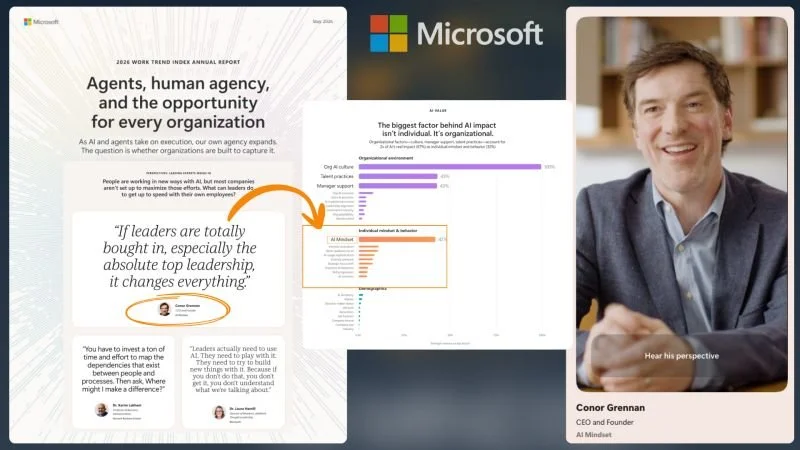
The number one factor in whether AI actually delivers value at work is not the tech skills of individual employee. It's the organization around them.
Not how much you've spent on tools. Not the endless prompt-a-thons run by the dude on LinkedIn telling you to copy-paste his mega prompt.
The organizational environment - culture, manager support, talent practices - accounts for 2x the AI impact of individual mindset and behavior.
Two. Times.
The strongest single factor? Organizational AI culture. It's roughly 2x more powerful than the top individual factor.
Which means...what exactly? Here's what.
It means you can have brilliant, motivated, AI-savvy people - and if the system around them doesn't support them, it barely matters.
It's like assembling the Avengers and then making them fight crime using only a Kia Sedona and a shared Google Doc.
This is huge. And it confirms something we've been saying at AI Mindset since day one. (More on that in a minute. Patience, friends. I know, it's hard after a couple of those lattes.)

THE TRANSFORMATION PARADOX
Okay here's where it gets spicy.
65% of workers fear falling behind if they don't use AI to adapt quickly.
But 45% say it feels safer to just focus on their current goals than to redesign how they work.
And only 13% - thirteen percent! - say they're rewarded for reinventing their work with AI.
Microsoft calls this the Transformation Paradox. (I call it the reason AI Mindset is in huge growth mode.)
Think about what this actually looks like inside a company.
People WANT to change. They KNOW they need to change. But the system around them - the metrics, the incentives, the norms - keeps rewarding the old way of working.
It's like your company announced a fitness initiative and everyone's fired up and ready to go and then the only thing in the break room is Doritos and the elevator still works fine, thank you very much.

MANAGERS ARE THE MULTIPLIER
When managers actively model AI use - not just encourage it, but visibly use it themselves - employees report a 17-point lift in AI value. A 22-point lift in critical thinking. And a 30-point lift in trust in agentic AI.
I can't state that enough. It means if you're a CEO and you spill coffee you better be grabbing Gemini and panic-hollering how to get the stain out of your Hermes.
When managers create psychological safety around experimentation, employees are 1.4x more likely to become high-frequency AI users.
Friends, this is the difference between encouragement and expectation.
Saying "you should try AI" is encouragement. It's the corporate equivalent of "you should really do yoga every morning." And just like yoga, everyone agrees it's a great idea and then absolutely nobody does it.
ONLY 19% ARE IN THE SWEET SPOT
Microsoft mapped workers across two dimensions: individual capability with AI and organizational readiness to support it.
Only 19% land in the "Frontier" zone where both are high.
10% are what they call "blocked agency." These are skilled people - good with AI, bought in, ready to go - stuck in organizations that haven't caught up. That's like giving someone a jet ski and then making them ride it in a swimming pool. While the lifeguard yells at them.
And half of all workers sit in the messy middle, where both capability and organizational support are still taking shape. That's a LOT of people just kind of... floating.
In many cases, people are ready. The systems around them are not.
AI NEWS THIS WEEK
IBM goes all-in on the operating model thesis at Think 2026
IBM rolled out its full enterprise AI stack this week. But the line that mattered was Arvind Krishna's: the enterprises pulling ahead aren't deploying more AI, they're redesigning how their business operates. Sound familiar?
Trump weighs pre-release vetting for frontier AI models
The Trump administration is reportedly weighing an executive order to vet frontier AI models before they ship. Yikes. Tech leaders are pushing back hard, warning that the move hands the AI race to China. The bigger signal for enterprise leaders: the regulatory floor is moving, and the "we'll figure governance out later" era is closing fast.
NYT Opinion: the AI job apocalypse probably isn't coming
The New York Times ran an opinion piece this weekend arguing that the AI job apocalypse probably won't happen, despite Dario Amodei predicting that half of entry-level white-collar work will vanish in five years. The case: every prior wave of automation grew employment, not killed it.
SO WHAT DO WE DO ABOUT IT?
AI Mindset was featured in this report - for the second time. And the findings match what we see every single day inside large enterprises.
Individuals absolutely need to change how they work with AI. That's table stakes. That's a huge part of what we do - training tens of thousands of people to think and work differently.
But individual capability without organizational support is like training a world-class athlete and then making them play on a field full of potholes.
The bottleneck right now is not people's skills or willingness. It's the system around them.
If you're a leader trying to figure out how to actually move your organization - not just buy tools and hope for the best - reply to this email. We'll send you the full report and talk you through what we're seeing work at scale.
Let's go, friends.